
Abstract
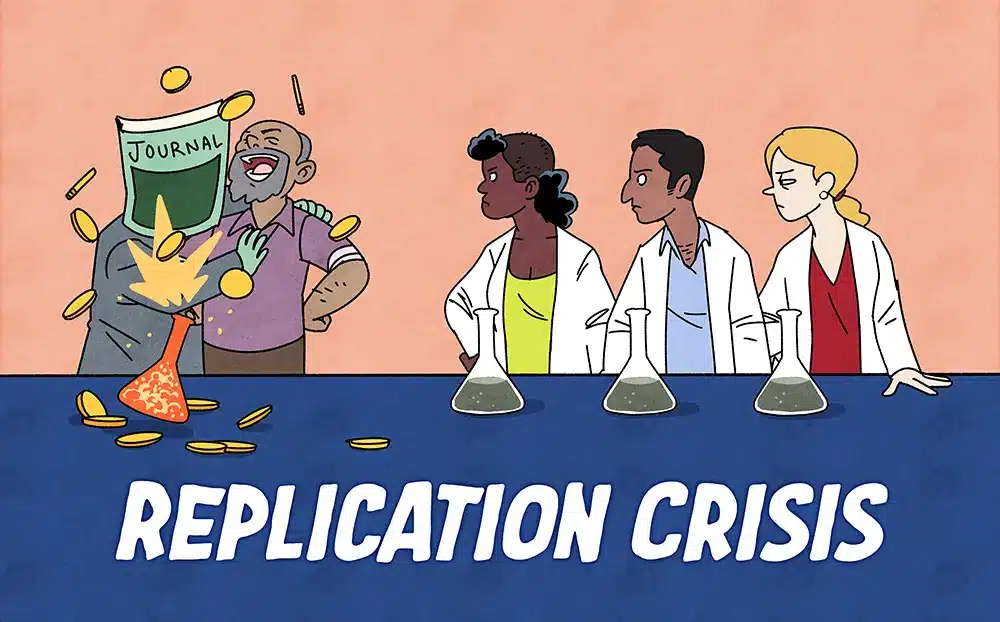
The reproducibility of scientific findings is a cornerstone of biomedical progress. Yet over the past two decades, increasing concerns have emerged regarding the inability of independent researchers to replicate a substantial proportion of published results. This phenomenon, widely referred to as the reproducibility crisis, has profound implications for clinical translation, public trust, and research funding efficiency. Simultaneously, the rapid integration of artificial intelligence (AI) into biomedical research has introduced both unprecedented analytical power and new layers of methodological complexity. This article critically examines whether AI is mitigating or exacerbating the reproducibility crisis, and raises essential questions that modern medical researchers must confront as they navigate this evolving landscape.
1. Introduction: A Crisis Hidden in Plain Sight
Biomedical science has historically operated under the assumption that rigorous methodology and peer review ensure the reliability of published findings. However, accumulating evidence suggests otherwise. Large-scale replication efforts in psychology, oncology, genomics, and preclinical pharmacology have demonstrated that a significant proportion of landmark studies cannot be reproduced under similar experimental conditions.
This phenomenon, often termed the reproducibility crisis, is no longer a marginal concern. It is now recognized as a systemic issue affecting the credibility of scientific literature and the efficiency of translational medicine.
At the same time, artificial intelligence—particularly machine learning and deep learning systems—has become deeply embedded in biomedical research pipelines. From image analysis in radiology to predictive modeling in epidemiology, AI is reshaping the way knowledge is generated. But an urgent question arises:
Is AI improving scientific reproducibility, or is it introducing new forms of irreproducibility that are harder to detect and correct?
2. Defining Reproducibility in the Modern Biomedical Context
Reproducibility is often confused with related concepts such as repeatability and replicability. For clarity:
- Repeatability refers to obtaining consistent results using the same data and methodology.
- Replicability involves achieving similar findings using new data under comparable conditions.
- Reproducibility extends further, encompassing the ability of independent researchers to validate findings using alternative methods or datasets.
In biomedical research, reproducibility is particularly challenging due to:
- Biological variability
- Small sample sizes in early-phase studies
- Complex multi-variable systems
- Ethical and logistical constraints in human research
The integration of AI adds another dimension: algorithmic opacity and dependence on computational pipelines that may not be fully transparent or standardized.
3. The Promise of AI in Enhancing Reproducibility
Artificial intelligence has been widely promoted as a solution to several longstanding limitations in biomedical science. Key advantages include:
3.1 Standardization of Analysis
AI-based pipelines can reduce human variability in data interpretation. For example, convolutional neural networks used in histopathology can apply consistent criteria across thousands of images, reducing subjective bias.
3.2 Scalability and Data Integration
Machine learning models can integrate heterogeneous datasets—genomic, clinical, imaging, and environmental—facilitating more robust multi-dimensional analyses that were previously infeasible.
3.3 Automation of Repetitive Tasks
By automating statistical modeling, feature extraction, and pattern recognition, AI reduces manual error and increases throughput.
3.4 Potential for Transparent Re-analysis
In theory, AI pipelines can be shared and re-executed across institutions, enabling computational reproducibility at a scale not previously possible.
Despite these advantages, the reality is more complex.
4. The Hidden Risks: Is AI Creating a New Reproducibility Problem?
While AI promises standardization, it simultaneously introduces new vulnerabilities that may worsen reproducibility.
4.1 The Black Box Problem
Many AI models, particularly deep learning systems, function as non-interpretable black boxes. Even when outputs are accurate, the internal decision-making process may be inaccessible. This raises a fundamental issue:
Can a result be considered scientifically reproducible if the underlying mechanism cannot be explained or independently verified?
4.2 Dataset Dependency and Hidden Bias
AI models are highly sensitive to training data. Small differences in dataset composition, labeling practices, or preprocessing steps can lead to dramatically different outputs. This introduces a subtle but critical form of irreproducibility that is difficult to detect.
4.3 Overfitting and False Discoveries
In high-dimensional biomedical datasets, AI models may identify patterns that are statistically valid but biologically meaningless. These false positives often appear robust in internal validation but fail in external replication studies.
4.4 Lack of Standardized Reporting
Unlike traditional clinical trials governed by CONSORT guidelines, AI-based studies often lack standardized reporting frameworks. As a result, essential details such as hyperparameters, preprocessing steps, and model selection criteria are inconsistently documented.
5. The Reproducibility Paradox in AI-Driven Research
A paradox is emerging in modern biomedical science:
- AI increases computational reproducibility at the technical level.
- Yet it may decrease scientific reproducibility at the interpretative level.
This paradox arises because reproducibility is no longer a purely methodological issue; it has become a socio-technical problem involving algorithms, datasets, infrastructure, and human interpretation.
For example, two research groups may use identical AI models but obtain divergent results due to differences in:
- Hardware configurations
- Software versions
- Random seed initialization
- Data preprocessing pipelines
Thus, reproducibility is increasingly dependent on computational ecosystems rather than just scientific methodology.

6. Implications for Clinical Translation
The reproducibility crisis has direct consequences for patient care and clinical decision-making.
- Drug development: Irreproducible preclinical findings contribute to high failure rates in clinical trials.
- Diagnostic AI tools: Variability in model performance across institutions raises concerns about safety and generalizability.
- Public health modeling: Inconsistent predictive models can lead to conflicting policy recommendations.
If AI systems are not rigorously validated across diverse environments, there is a risk that they may amplify rather than reduce translational uncertainty.
7. Ethical and Epistemological Considerations
Beyond technical concerns, AI challenges the epistemological foundations of biomedical science.
Traditionally, scientific validity depends on:
- Transparency of methods
- Logical reasoning
- Empirical verification
However, AI introduces probabilistic reasoning that may not align with classical scientific explanation. This raises several philosophical questions:
- Is predictive accuracy sufficient for scientific truth?
- Can a model be trusted if it cannot be interpreted?
- Should reproducibility be defined differently in computational sciences?
These questions remain unresolved but are increasingly urgent.
8. Toward a Solution: Strengthening Reproducibility in the AI Era
Addressing these challenges requires a multi-layered approach.
8.1 Open Science and Data Sharing
Mandatory sharing of datasets, code, and preprocessing pipelines can significantly improve reproducibility.
8.2 Standardized AI Reporting Guidelines
The development and enforcement of reporting standards for AI-based biomedical research are essential. These should include:
- Model architecture details
- Training and validation procedures
- Data provenance
- Hyperparameter configurations
8.3 Independent Algorithmic Auditing
Just as clinical trials undergo external monitoring, AI models should be subject to independent auditing to assess robustness and bias.
8.4 Multi-Center Validation
AI models must be tested across diverse populations and healthcare systems to ensure generalizability.
8.5 Emphasis on Interpretability
Where possible, interpretable models should be preferred over opaque architectures, especially in clinical contexts.
9. Critical Questions for Contemporary Researchers
As biomedical science enters a computationally intensive era, researchers must confront several fundamental questions:
- Are we prioritizing predictive performance over scientific understanding?
- Can reproducibility be achieved without full transparency of AI systems?
- How do we define scientific validity in probabilistic models?
- Are current peer-review systems equipped to evaluate AI-driven research?
- What is the responsibility of researchers when models perform well but lack interpretability?
These questions are not theoretical—they directly influence the trajectory of biomedical innovation.
10. Conclusion
The reproducibility crisis in biomedical research is neither new nor resolved. However, the integration of artificial intelligence has transformed it into a more complex and less visible phenomenon. While AI offers powerful tools for standardization and analysis, it also introduces new layers of opacity, dependency, and methodological fragility.
The central challenge for modern medical researchers is not merely to adopt AI, but to critically evaluate its epistemological implications. Reproducibility must be redefined in a way that accommodates computational complexity without sacrificing scientific rigor.
Ultimately, the future of biomedical science will depend on whether researchers can strike a balance between innovation and verifiability. The question is no longer whether AI can accelerate discovery, but whether it can do so without undermining the foundational principle that science must be reproducible.
What can We Do for You?